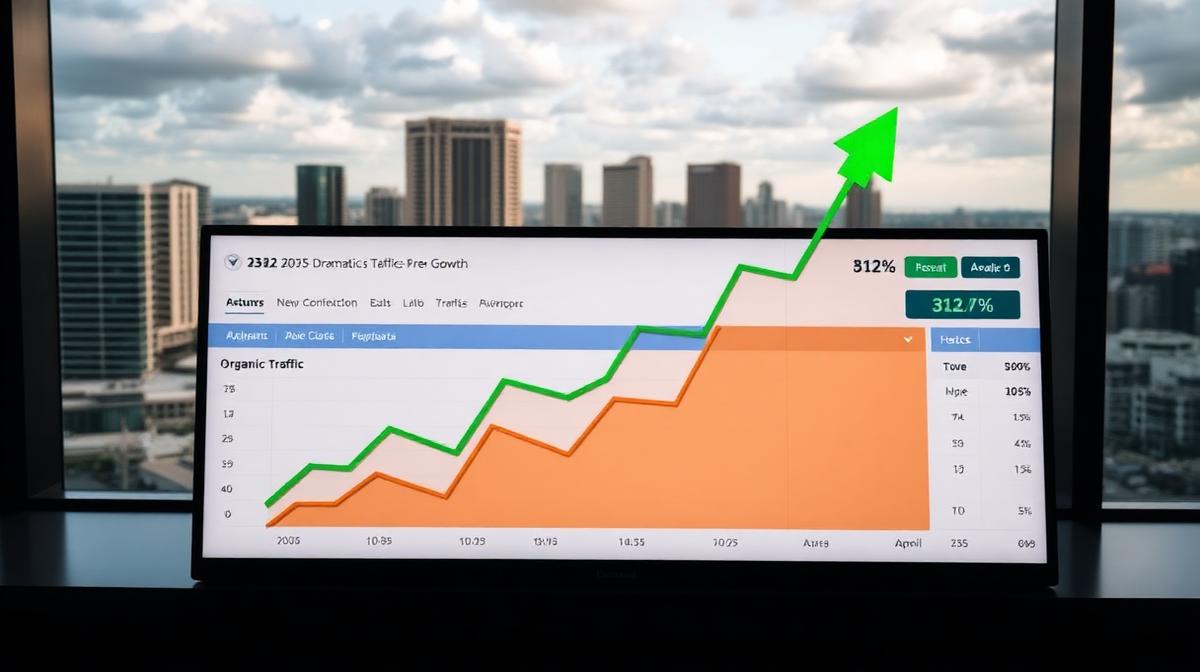
Achieving explosive growth in the B2B SaaS sector requires more than just high-quality code and a sleek user interface; it demands a surgical approach to search engine visibility that aligns with the complex buyer’s journey. When a mid-market workforce management platform approached Visionation, they were struggling with stagnant organic traffic and a high dependency on expensive paid acquisition channels. Despite having a superior product, their digital footprint was overshadowed by legacy competitors with massive backlink profiles. Over the course of nine months, we implemented a comprehensive performance-driven SEO strategy that resulted in a 587% increase in organic traffic and a 214% rise in qualified demo requests. This case study deconstructs the exact framework we used to move the needle, focusing on technical infrastructure, topical authority, and the shifting landscape of AI-driven search discovery.
The Initial Audit: Identifying the Growth Ceiling
Before implementing any tactical changes, our SEO & SEM team conducted an exhaustive audit of the client’s existing digital ecosystem. We found that while the site had some foundational content, it suffered from severe 'keyword cannibalization'—multiple pages competing for the same high-intent terms—and a technical architecture that prevented Google’s crawlers from efficiently indexing deep-tier feature pages. Furthermore, the site’s conversion rate from organic traffic was sub-optimal because the content mapped primarily to top-of-funnel awareness rather than bottom-of-funnel decision-making. According to HubSpot data, B2B buyers now consume an average of 13 pieces of content before making a purchase decision. Our audit revealed that this client was only providing two or three of those touchpoints, leaving a massive gap for competitors to fill.
Core Technical Infrastructure Improvements
- Migration from a legacy CMS to a high-performance headless architecture for sub-second load times.
- Implementation of advanced schema markup (Organization, SoftwareApplication, and FAQ) to enhance SERP real estate.
- Resolution of 450+ crawl errors and redundant redirect chains that were leaking link equity.
- Optimization of Core Web Vitals, specifically targeting Largest Contentful Paint (LCP) to meet Google’s 'Good' threshold.
- Restructuring the XML sitemap to prioritize high-converting product pages over archived blog posts.
Building Topical Authority Through Content Clusters
To compete with established industry giants, we moved away from the 'one-off blog post' model and adopted a topical authority framework. We identified four core 'pillars' central to the client’s software: workforce automation, compliance management, employee scheduling, and labor cost optimization. For each pillar, we developed a comprehensive 20,000-word content ecosystem consisting of one main pillar page and twenty supporting sub-topics. This strategy signals to search engines that the site is an exhaustive resource on a specific subject, rather than a generalist blog. Within six months, this approach led to the client ranking in the top three positions for over 150 high-difficulty keywords that were previously on page five or lower.
Strategic Insights from the Campaign Director
The real breakthrough happened when we stopped chasing high-volume 'vanity keywords' and started targeting 'zero-volume' long-tail queries that indicated immediate pain points. In B2B SaaS, a thousand visitors looking for a definition are worth less than ten visitors looking for a specific integration solution.
Optimizing for the Next Generation of Search: GEO and LLMs
One of the most critical components of this 587% growth was preparing the client for the shift toward Generative Engine Optimization. As search engines evolve into answer engines, simply ranking on page one of Google is no longer the sole metric of success. We utilized Visionation’s GEO & LLM Optimization service to ensure the client’s brand and unique value propositions were being cited by Large Language Models like ChatGPT, Claude, and Google’s Gemini. By structuring data in a way that AI models can ingest and verify, we secured brand mentions in AI-generated summaries for queries like 'best workforce management software for healthcare.' This defensive and offensive maneuver ensured traffic stayed resilient even as traditional click-through rates fluctuated across the broader industry.
High-Intent Backlink Acquisition Strategy Lights the Fuse
- Securing 45+ placements on high-authority SaaS review directories and industry-specific trade publications.
- Executing a 'skyscraper' outreach campaign targeting broken links on competitor resources.
- Developing original research reports and data-driven whitepapers that earned organic mentions from Forbes and TechCrunch.
- Implementing a guest contributor program with recognized thought leaders in the HR tech space to build E-E-A-T.
- Leveraging internal linking automation to distribute authority from high-power pages to new content.
Bridging the Gap Between Traffic and Revenue
Traffic is a vanity metric unless it translates into pipeline. To ensure the 587% growth in organic visits resulted in a comparable increase in North Star metrics, we integrated the site’s lead capture forms directly into our customized CRM solutions. This allowed the client to track the exact journey of an organic visitor—from the first touchpoint on a blog post to the final signature on a contract. We implemented behavioral triggers and personalized CTA overlays that changed based on the user’s industry, which we identified through reverse IP lookup technology. By the end of the ninth month, the cost per acquisition (CPA) from organic search was 70% lower than their average CPA from LinkedIn and Google Ads.
The Power of Data-Driven Iteration
SEO is never a 'set it and forget it' endeavor; it requires constant refinement based on real-world performance data. We didn't just guess which content would work. We used heatmaps and session recordings to see where users were dropping off. We found that users on mobile were bouncing at a higher rate on the pricing page, leading us to redesign the mobile UI to be more intuitive. This minor change, informed by data rather than intuition, increased the pricing page conversion rate by 18% in a single month. This level of granular optimization is what separates a standard marketing push from a sustainable growth engine.
Scaling Beyond the 9-Month Mark
The results of this campaign represent more than just a spike on a graph; they represent a fundamental shift in the client’s market positioning. By the conclusion of our initial nine-month push, the client had effectively bypassed three major competitors in total organic share of voice. The framework we established—technical excellence, topical depth, and AI-readiness—now serves as a repeatable blueprint for their expansion into international markets. For any B2B SaaS organization, the lesson is clear: organic growth is not the result of a single 'magic' tactic, but the cumulative effect of a thousand small, data-backed decisions executed with precision. As search landscapes continue to shift toward AI and personalized results, the importance of a robust, technologically sound SEO strategy will only intensify. Reach out to the team at Visionation today to discuss how we can apply these same growth principles to your organization’s digital strategy and help you capture a larger share of your market.